



 Stamp Services
| Stamp sn | D777 |
|---|---|
| Stamp Name | Sp.777 Pokémon Souvenir Sheet |
| Stamp Cat Standard | Special Stamps |
| Stamp Cat | Childrens Plays,Mammals,Leisure Activitics,Animals,Plants |
| First day of issue | 2026-11-20 |
| Suspension Date | |
| Dimension of stamps(mm.) | 28 × 38 or 22 × 30 (mm) |
| Size of souvenir Sheet (mm.) | 185 × 100 (mm) |
| Printer | Royal Joh. Enschede B.V. (Netherlands) |
| Drawer | |
| Designer | The Pokemon Company |
| Photographer | |
| Engraver | |
| Planner | |
| Sheet composition | |
| Color | Colorful |
| Process | Offset |
| Paper used | Self-adhesive stamp paper |
| Back | |
| Perforation |
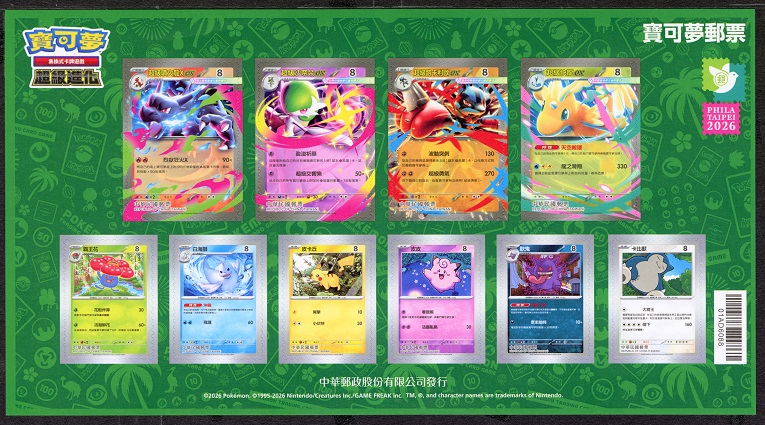
The PHILATAIPEI 2026 World Stamp Championship Exhibition is held from November 20 to 25, 2026, at the Taipei World Trade Center Exhibition Hall 1. In conjunction with the exhibition’s Treasure Day, Chunghwa Post has issued a souvenir sheet featuring widely loved and world-famous Pokémon Trading Card Game. The souvenir sheet contains ten stamps, each with a face value of NT$8, printed on self-adhesive stamp paper.
Showcasing dazzling card artwork, the stamp designs feature Pokémon Trading Card Game illustrations of Mega Charizard X ex, Mega Gardevoir ex, Mega Lucario ex, Mega Dragonite ex, Vileplume, Dewgong, Pikachu, Clefairy, Gengar, and Snorlax.
To purchase postage stamps, please go directly to the post office branches, Postal Museum or order on line at https://stamp.post.gov.tw.